Two primitives
A harness.yaml is mostly slots and rules. Other objects preserve execution facts without expanding the author model.
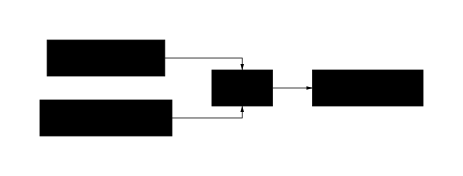
Slot
A Slot gives an artifact a stable name, kind, and materialization path.
slots:
  brief: { kind: file, path: request/brief.md }
  candidate: { kind: git, path: artifacts/candidate }
  report: { kind: file, path: artifacts/report.md }
Each committed version in a Slot is an immutable Revision. The kernel can therefore identify exactly what a Rule read and decide whether an existing output still matches the current inputs.
Rule
A Rule declares its inputs, outputs, and execution method.
rules:
  - id: write_report
    in: [brief, candidate]
    out: [report]
    run: "printf '# Report\n' > out/report"
At execution time, inputs appear under in/ and declared outputs must be written under out/. A successful Attempt commits every output atomically. Failure, timeout, or a missing output leaves no partial Revision.
Runtime facts
| Name | Meaning |
|---|---|
| Revision | An immutable artifact version in a Slot |
| Activation | A Rule paired with an exact input Revision frontier |
| Attempt | One execution of an Activation |
| Receipt | The reusable record of a successful execution |
A Lease prevents multiple workers from owning the same Activation. A Session lets an executor retain controlled context across related runs. Both are runtime mechanisms.
Three common execution methods
A Shell Rule runs a command. An Agent Rule delegates semantic work to an executor. A Human Rule pauses for a responsible decision.
All three share Slot and Rule dataflow, so they compose in the same graph.