How graphs emerge
HarnessGraph does not ask authors to select a serial, parallel, or loop graph. The coordinator derives those shapes from Slot reads and writes.
Serial work
When Rule B reads Rule A's output, B waits for A to commit a Revision. No separate ordering declaration is needed.
Parallel work and joins
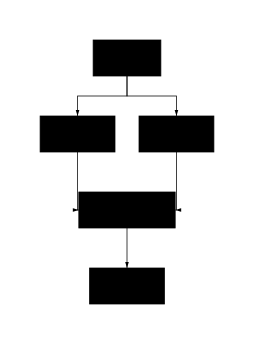
Two Rules that share an upstream input but do not read each other's outputs may run together. A downstream Rule that reads both outputs forms a join. --jobs limits execution capacity; it does not define graph semantics.
Conditions
A when clause evaluates Rule eligibility on the current input frontier. Data used by the condition should appear in in so the decision is bound to exact Revisions.
- id: publish
  in: [candidate, approval]
  out: [release]
  when: "test \"$(jq -r '.decision' approval)\" = approve"
  run: "cp in/candidate out/release"
Loops
A loop comes from Revision feedback. A critique Rule updates critique. A coding Rule reads the new critique and updates candidate. When the critique becomes accept, the coding Rule's when clause stops being eligible and the graph stabilizes.
There is no program counter and no Loop node. Each round is a new Activation formed from new input Revisions.
Failure and retry
A failed Attempt commits no output. A retry still belongs to the same Activation and follows limits for attempts, timeout, backoff, and cancellation. Changed inputs create a new Activation, separate from the earlier failure record.
See the smallest feedback cycle in Pomodoro. Use the Graph semantics lab for parallel, conditional, feedback, and unusual topologies.